Ladder logic · Motor control · Puzzle game
Program a Mitsubishi-style PLC on a grid editor, hit Run, and watch power flood the rung while a real machine moves in 3D beside it. Fifty-three work orders take you from one contact driving one coil to a PID loop holding a tank on setpoint, and on to a whole excavator plant written in seven program sections, where the job is no longer to make a machine work but to find out which of six stations is holding the line up.
Work order: the motor must run when X0 is pressed, keep running after it
is released, and stop on X1. A momentary button only makes contact while it is
held, so the rung has to remember. Place a parallel Y0 contact around the start
button to hold itself in.
The bench
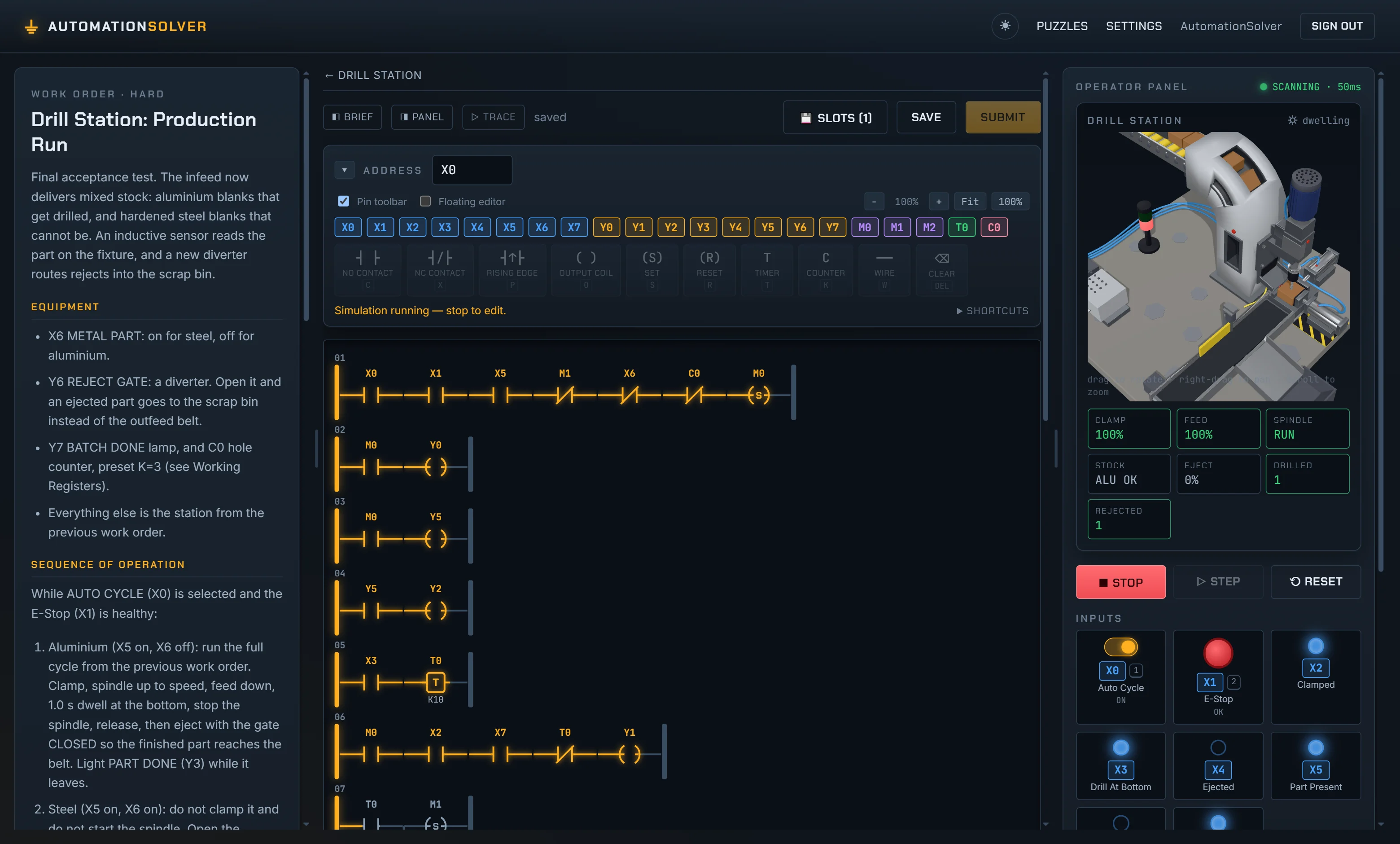
The work order reads like a machine manual. The editor is a grid you fill with contacts, coils, timers and function blocks. The operator panel has real push buttons, e-stops, lamps and analog trends bound to X and Y addresses. Press Run and the rung lights up cell by cell as power floods it from the left rail.
One letter places an instruction, arrows move the selection across rungs, and digit keys hold operator buttons, so the two-hand safety press can genuinely need both hands.
Every failing scenario gets a button that re-runs it scan by scan with a scrubber. Jump to the first failing scan and watch the rung that did it.
A logic-analyzer view, one row per device, filled where the bit is high. Word registers draw as strip charts, because a regulator cannot be judged from one number.
The machines
Nothing animates on its own. Every transform is a pure function of the state the process model
computed from this scan's dt, so what you see is what the grader saw. Five scenes
are hero models authored in Blender and loaded as glTF; three are drawn procedurally, because
when the subject is a number moving, a grid of stock, or the same excavator seen at every
stage of its own build, a shape that is that state reads better than a model
whose parts you would only be switching on and off.
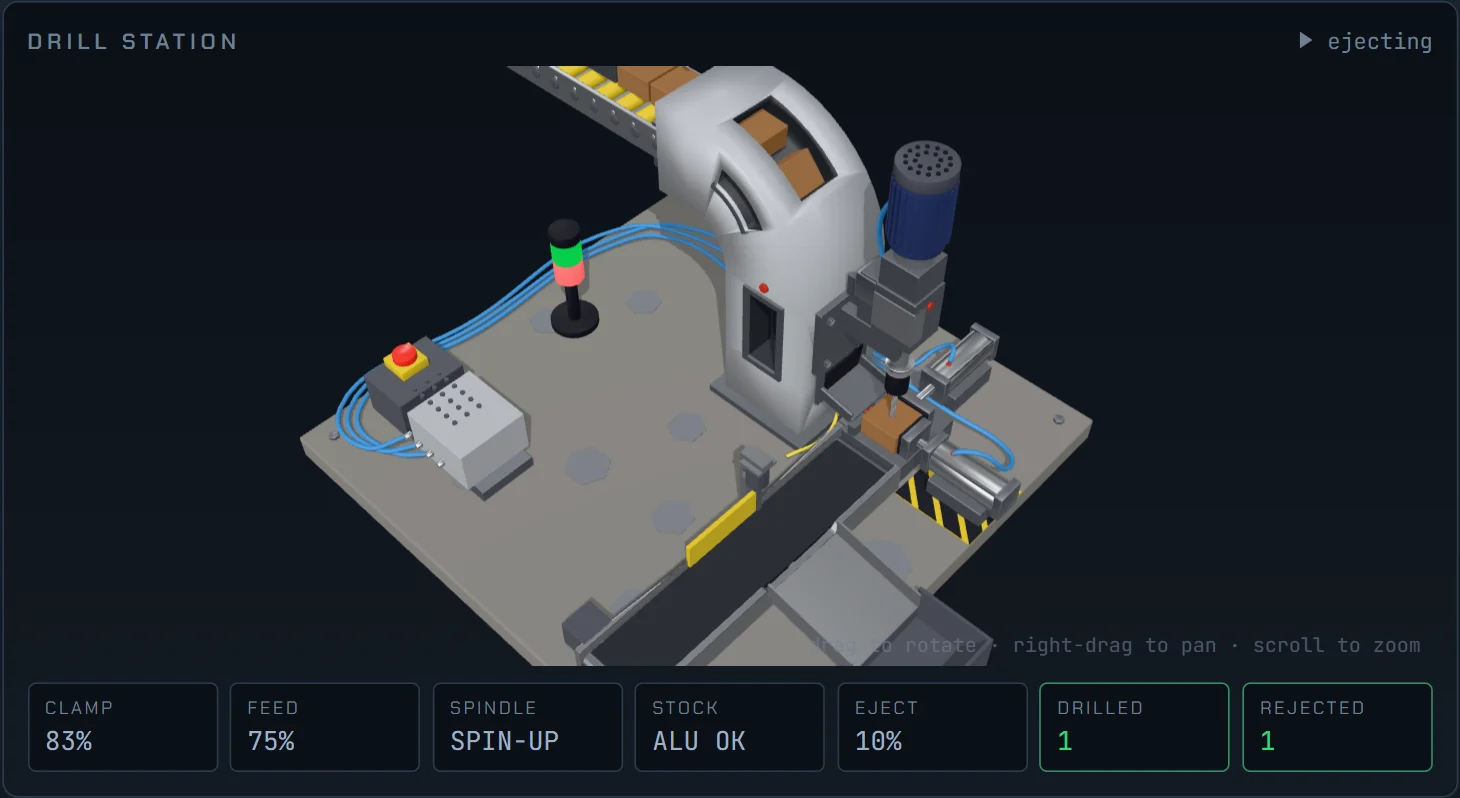
Drill Station glTF
Advance the feed into an unclamped part and the bit snaps. Mixed stock arrives on the infeed, and hardened steel has to go down the reject chute undrilled.
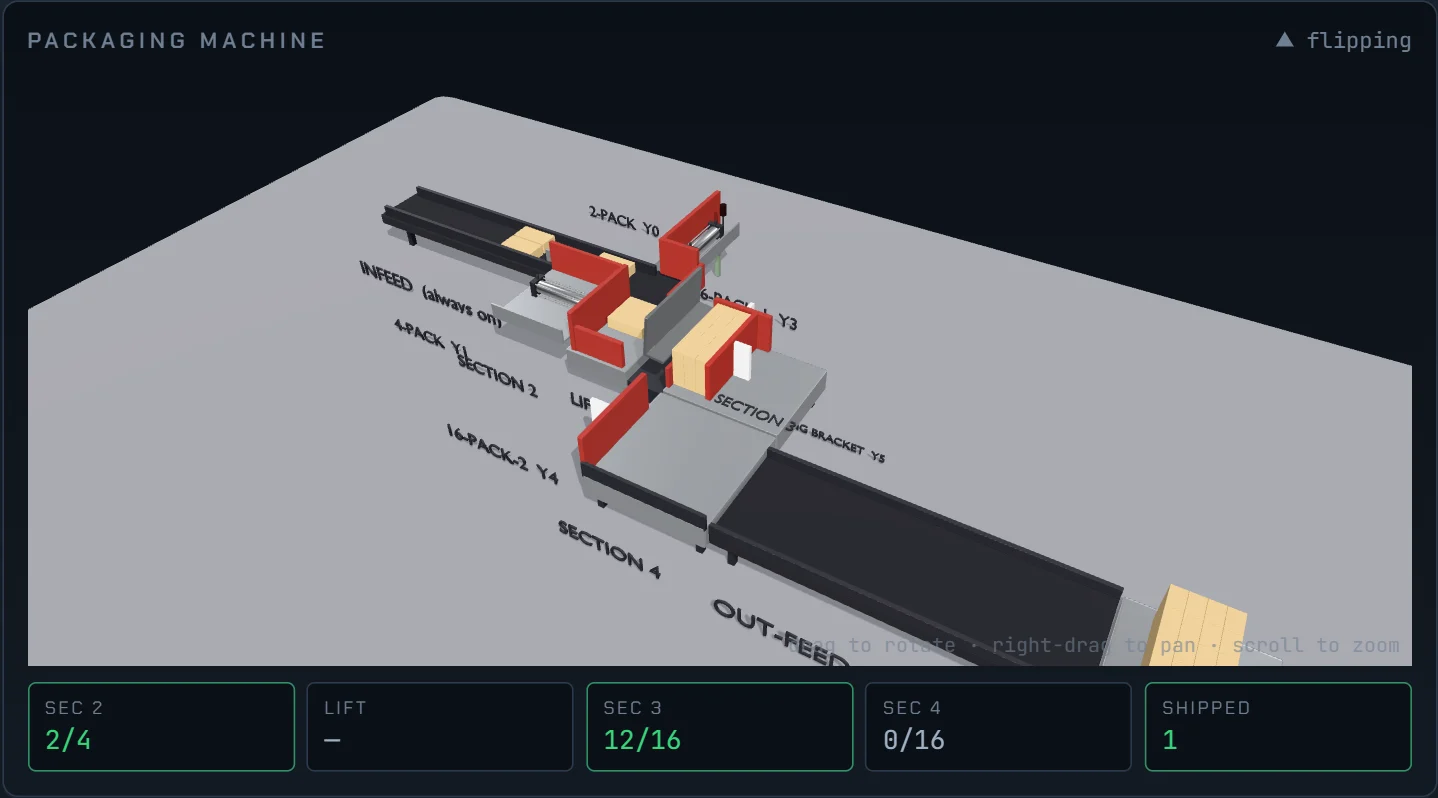
Packaging Machine glTF
Six double-acting actuators, a lift that flips its load over a wall so cartons stand on end, and a retaining bracket holding the stack up while a plate sweeps past it.
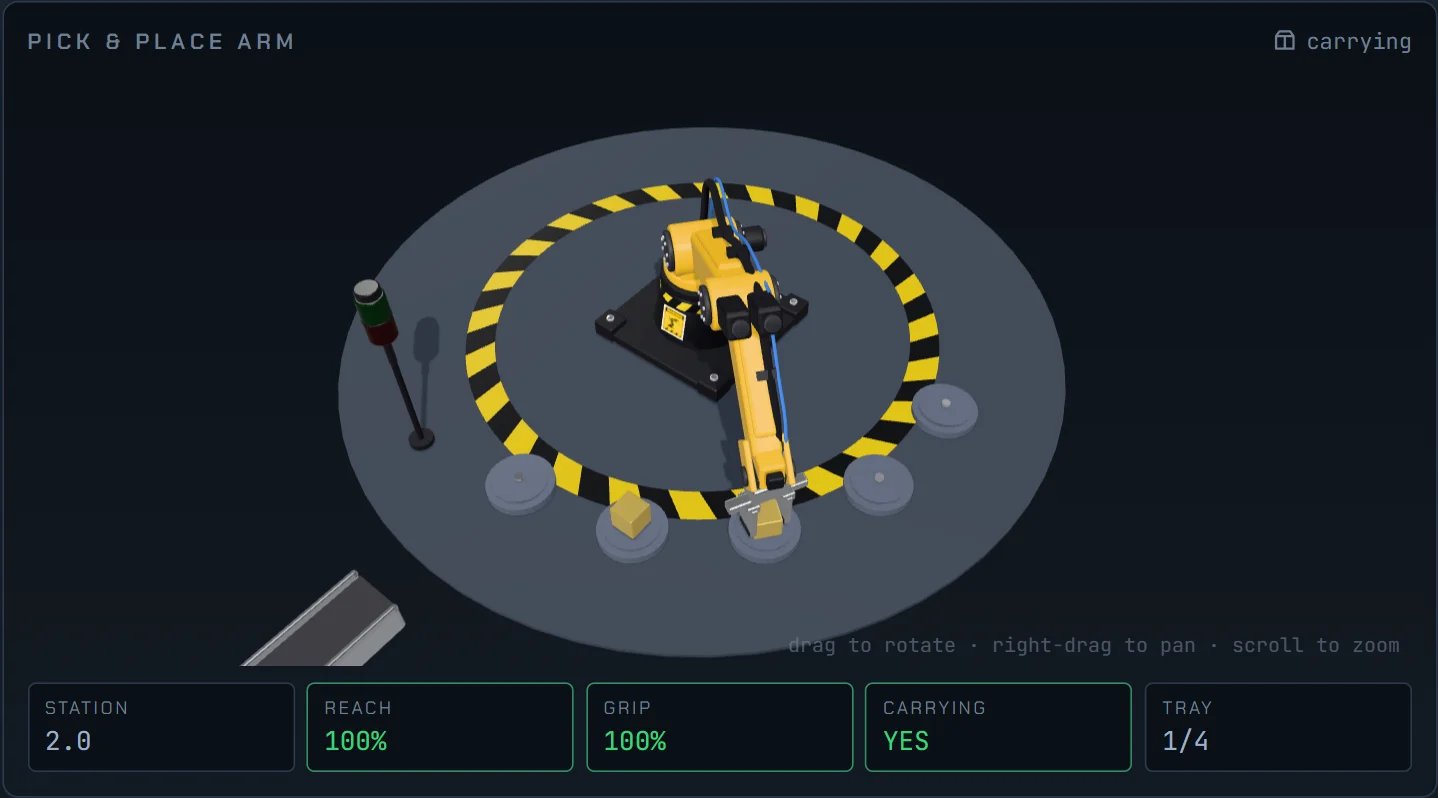
Pick & Place glTF
A two-link arm reaches on an IK path so the gripper stays plumb. It cannot swing with the reach extended, and placing into an occupied pad is a jam, not a warning.
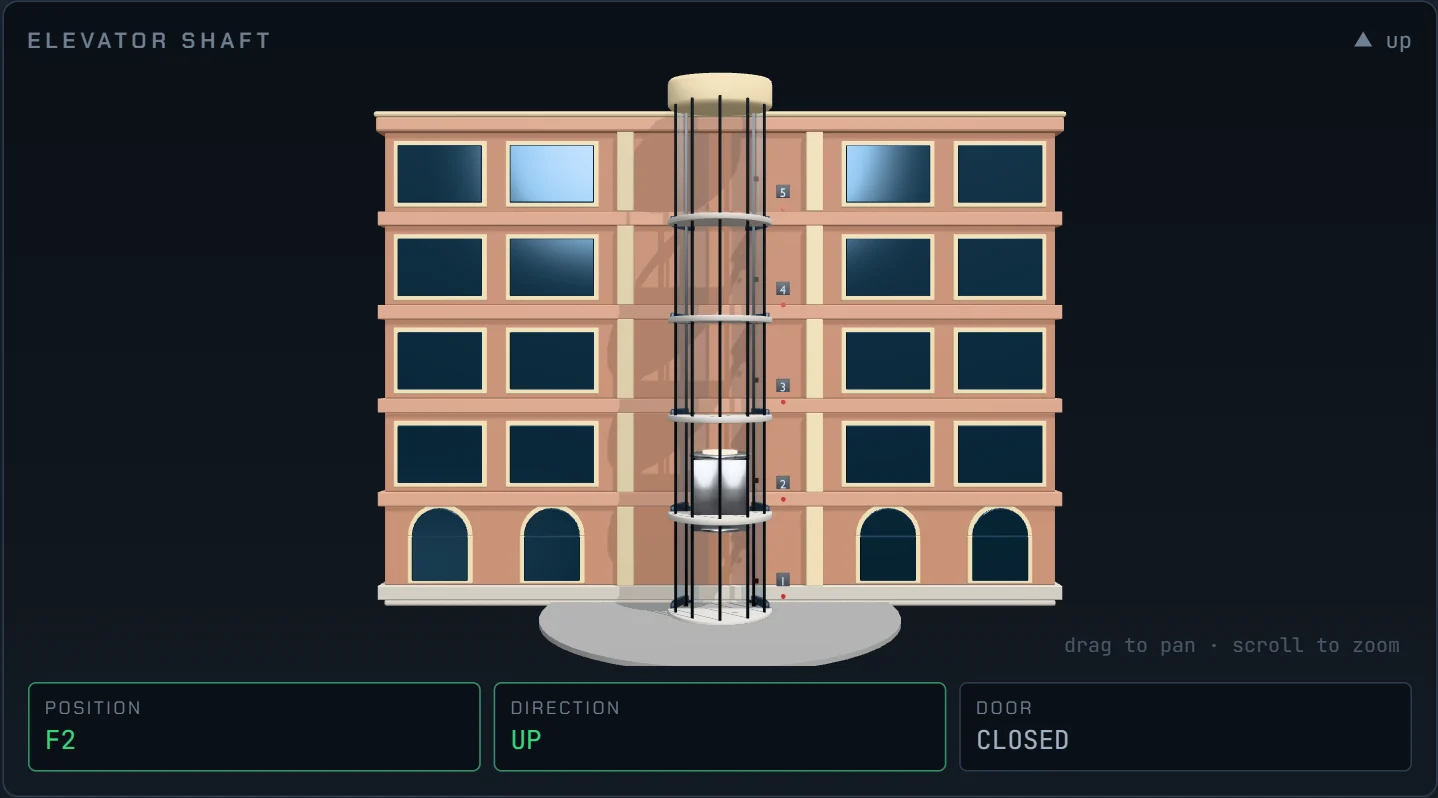
Elevator glTF
The door interlock is enforced in the machine, not the grader: command the car with the doors open and it simply refuses to move.
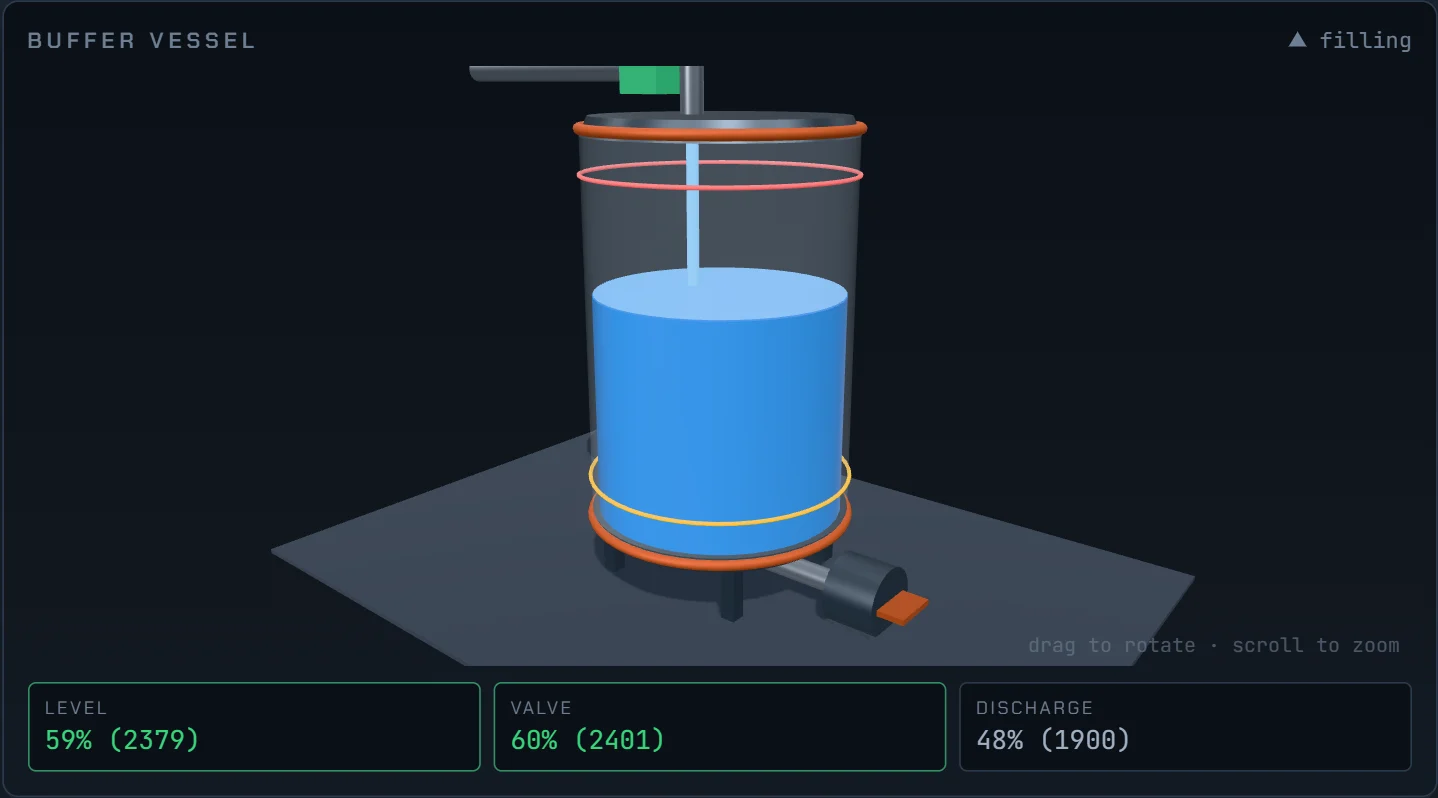
Process Control procedural
The inlet stream's radius is the valve opening, so a modulating valve is legible at a glance. Transmitters report raw counts; scaling them is the first lesson.
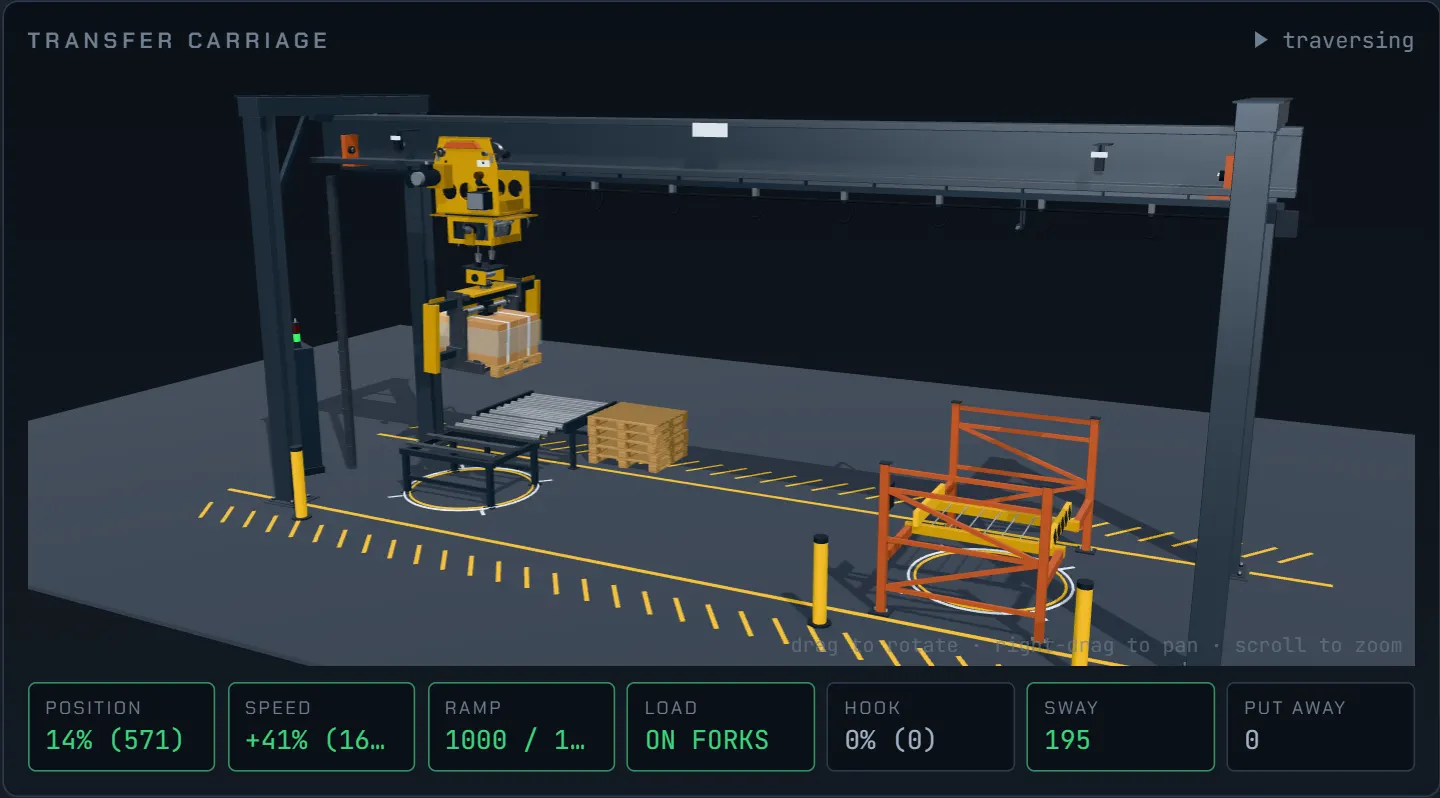
Motion Control glTF
The drive ramps toward whatever the accel and decel parameter registers currently say, and the load keeps swinging on its rope after the trolley stops.
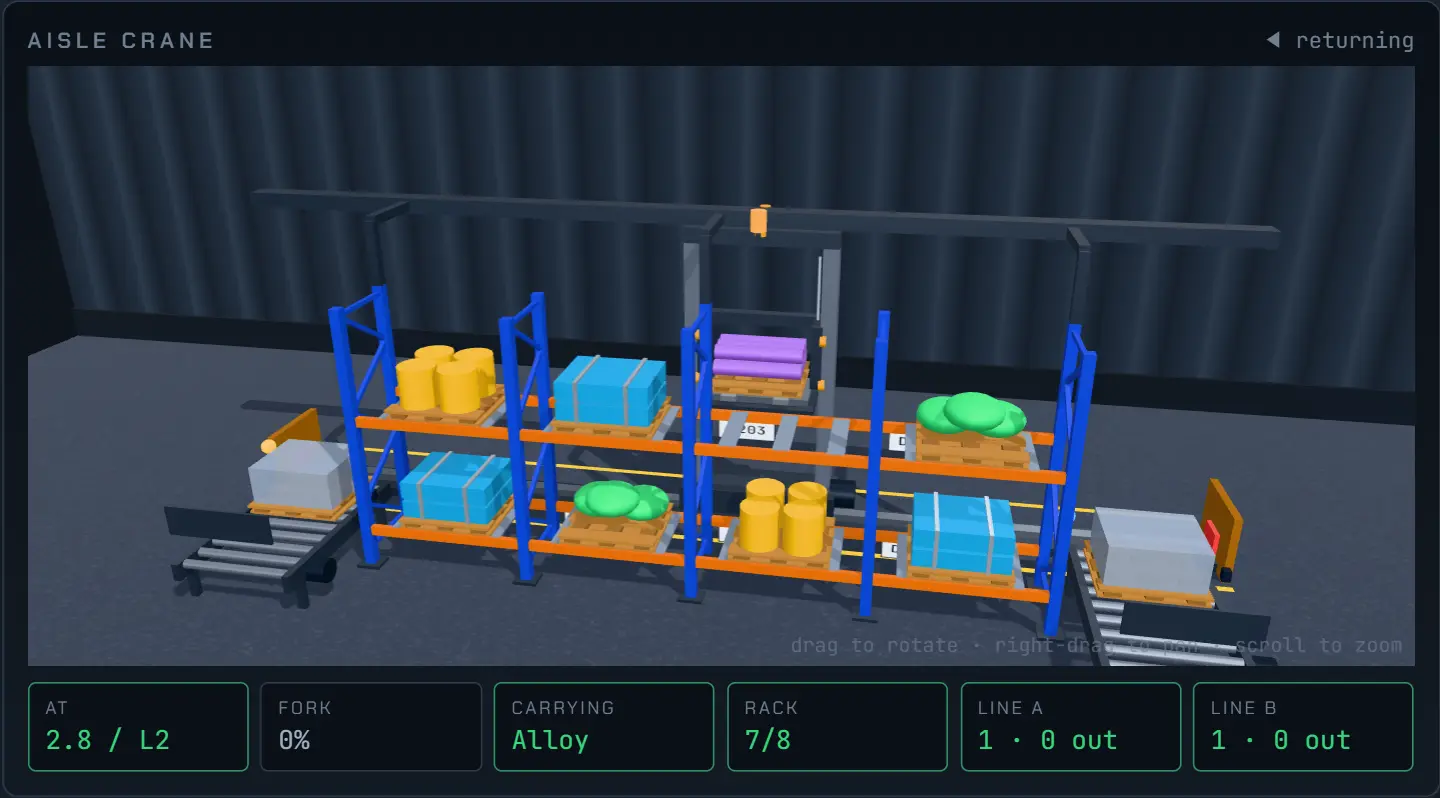
Automated Warehouse procedural
Every slot wears the WMS register the program reads, and every material has its own load shape as well as its own color, so a mis-delivery is visible before the grader says so.
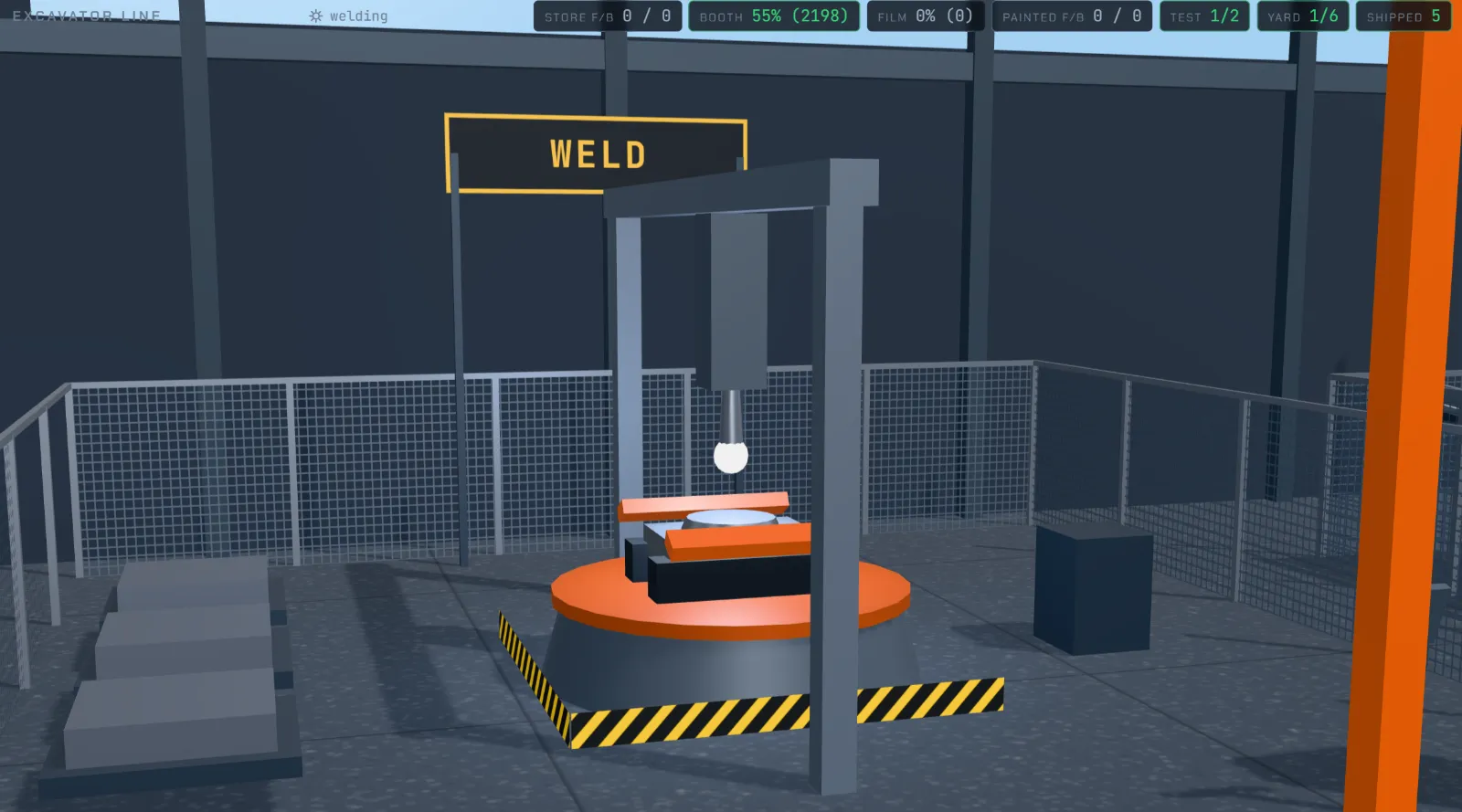
Excavator Plant procedural
Drawn in code rather than imported, because the same excavator is on screen at every stage of its own build: the geometry has to grow parts and recolor them as it moves down the line.
Second genre
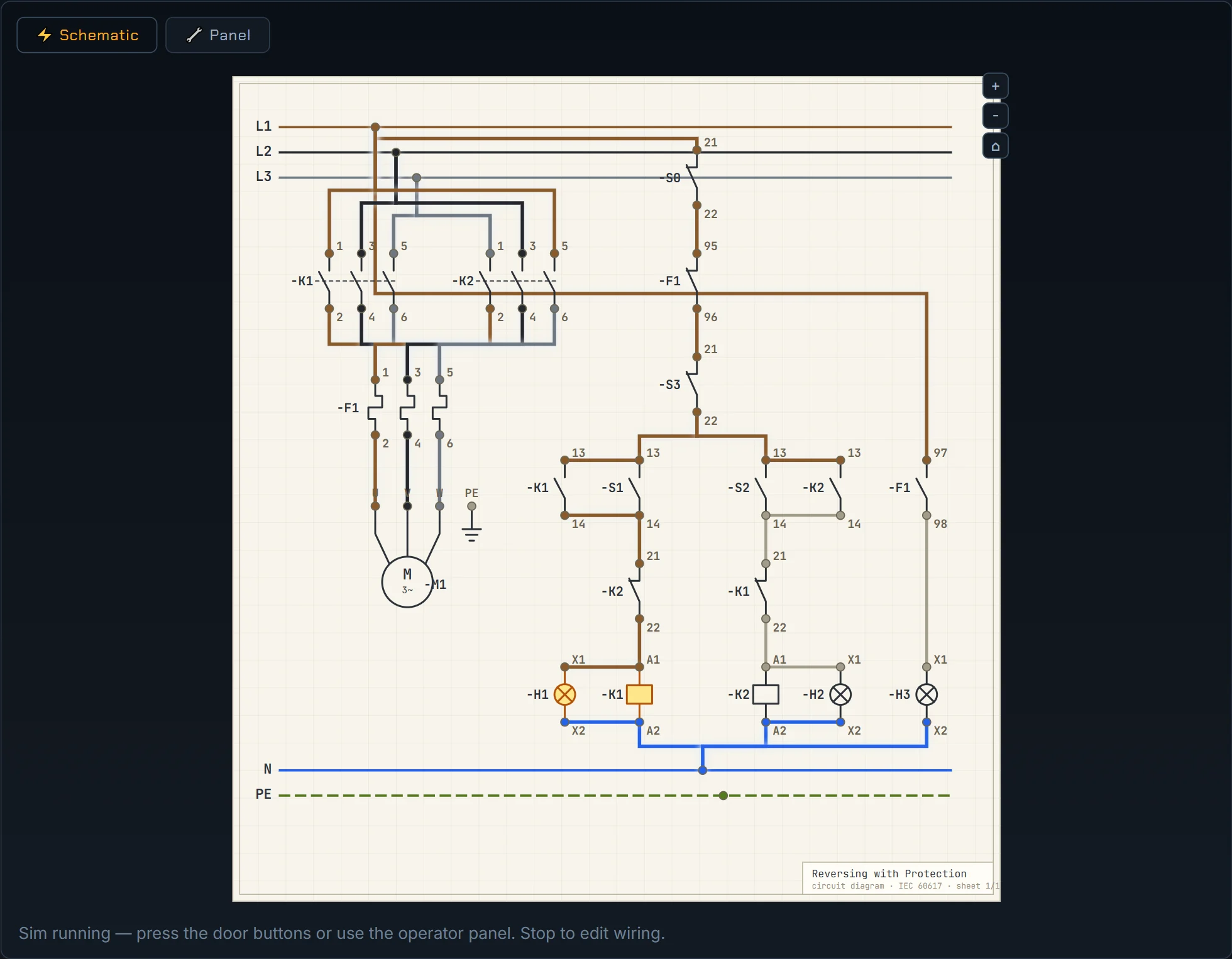
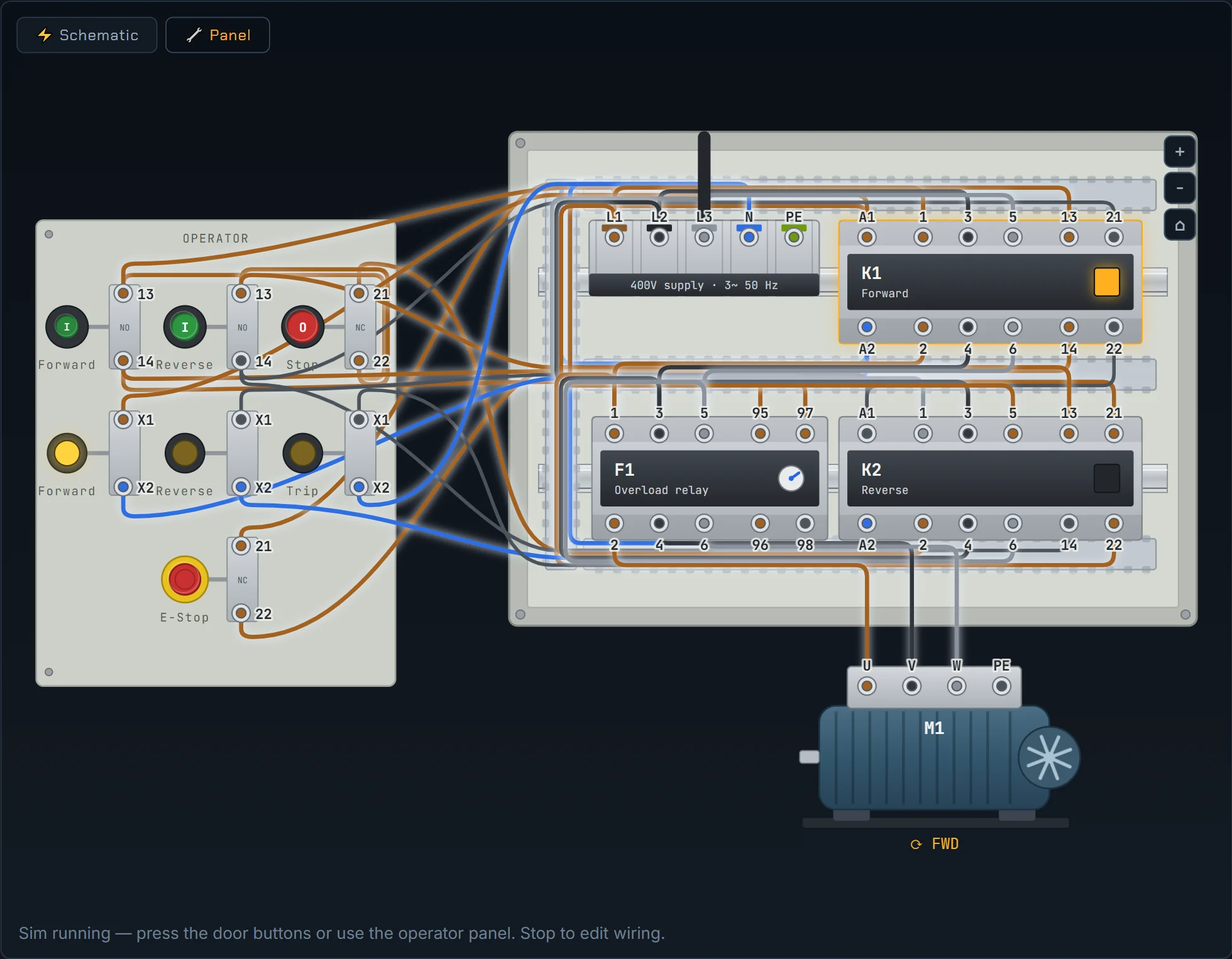
Six work orders drop ladder logic entirely. You wire the terminals of fixed components using IEC numbering, and the same document is editable from two views. Wires and terminals color by live net potential. Merge two supply potentials onto one net and the breaker trips, exactly as it would in the panel.
Schematic view
Components break into their distributed parts with -K1 cross-references,
and wires run as Manhattan paths between them.
Panel view
DIN rails, slotted ducts, a door strip of real operators and a finned motor. Wires route orthogonally through the ducts, and door wires hang as a loose harness.
The excavator plant
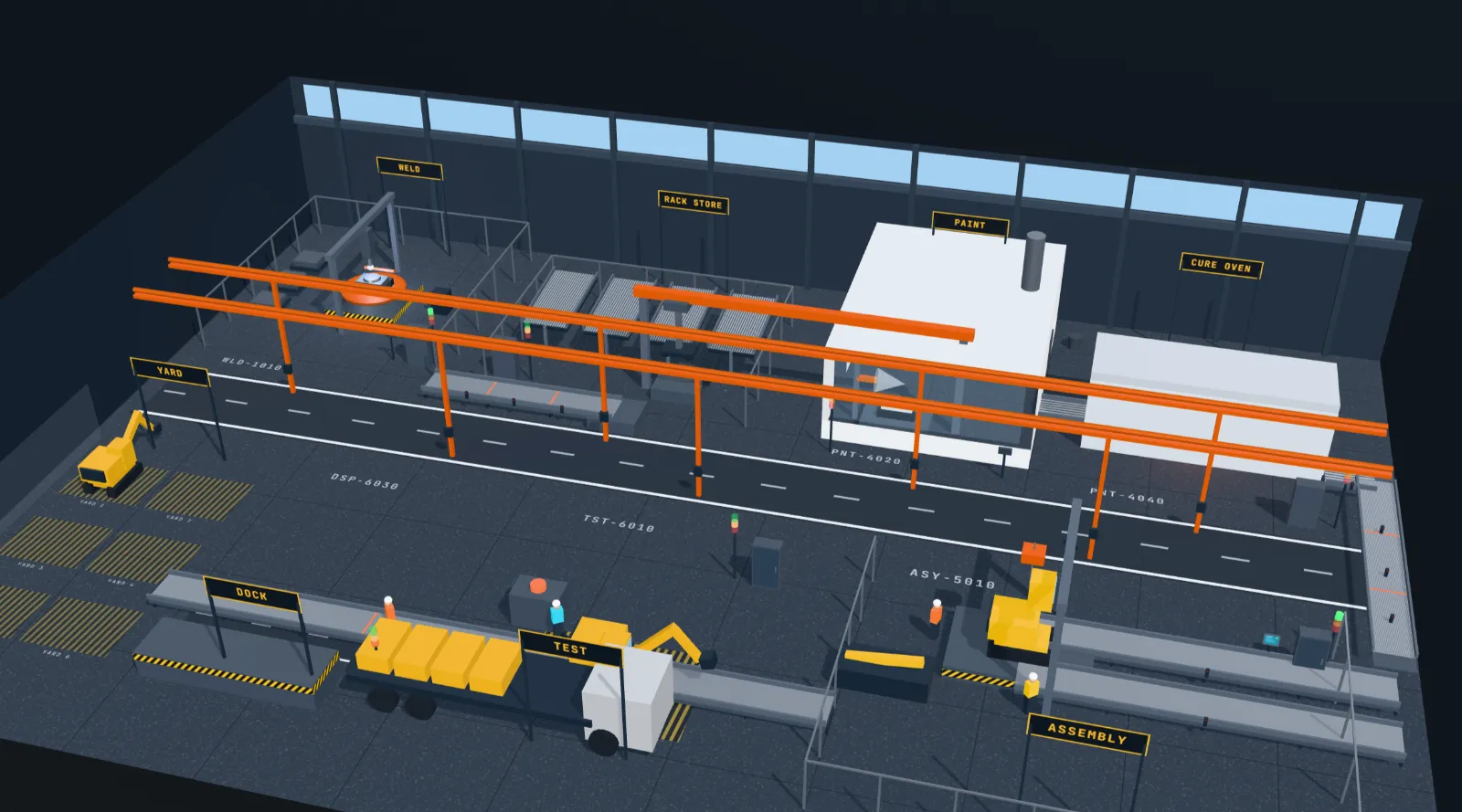
The last seven work orders share one floor: 55 by 38 metres of shop with a weld bay, a rack store, a portal robot, a spray booth and cure oven, a final-assembly jig, a test bay and a dock with a haulier who will not wait. A factory is not a bigger machine. It is several machines that only work as one, and almost everything hard about it lives in that word.
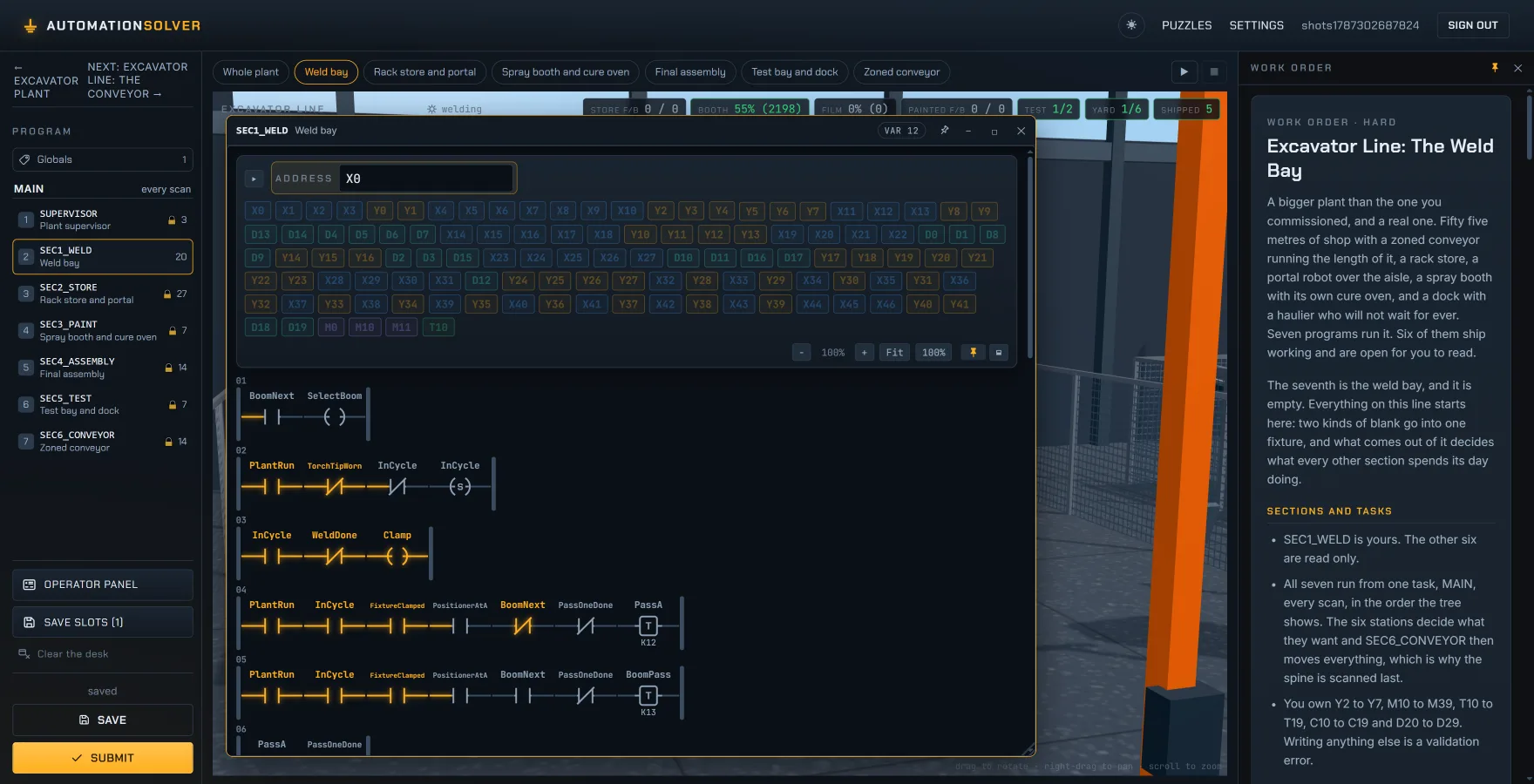
The program is a tree of POUs on a task, not one long ladder. Six sections ship written and read-only; the one you were hired for is empty. A section that writes a relay it does not own is a validation error, not a bug found next week.
Parts do not teleport between stations. The conveyor spine is twelve zones and a seventh program section, so a part left standing on an infeed is a part the station behind it cannot release.
Every station has a plain program that works and a better one costing about the same number of rungs. Welding every boom twice runs the line and never faults. It also gives away 3.6 seconds on the first two parts, and the par times notice.
The plant is the workspace, and the programs float above it in windows you open per section.
Rungs here are written in names rather than addresses: a declaration binds
FixtureClamped to a bit once, so renaming is free and the engine never learns
that variables exist. The capstone hands you all six stations already working and asks the
only question that matters on a real line: which one is holding it up?
Work orders
Each category is its own ladder of difficulty, starting from something you can finish in a minute and ending in a capstone that combines everything in it.
Scoring is 85 marks for scenarios passed plus 15 for performance, and the performance marks only land once everything passes. Sequencing jobs spend them on cycle time against a declared par; regulating jobs spend them on integral of absolute error. So a correct but leisurely program is solved and unlocks what follows, and still has to be pipelined to reach 100.
One engine, both sides
packages/client
Contacts and coils drop onto a rung grid, just like a real MELSEC program. Series is AND, parallel branches are OR, and every scan the solver floods power from the left rail so you see exactly which cells are live.
packages/shared
A pure-TypeScript engine with zero runtime dependencies. It advances only by an explicit
dt, never the wall clock, so the same program always produces the same trace.
The lint config bans Date and Math.random here to keep it true.
packages/server
Submit, and the server replays your program through the same engine against scripted scenarios, machine dynamics included. Client and server agree bit for bit, by construction.
That is the architectural bet of the whole project: one simulation engine, shared by live play and grading. There is no second implementation to drift, and this page is not an exception to it. The demo at the top imports that engine: the scan animating the rung, the validator that checks its structure and the grader that scored it when you pressed Submit are the shipped code, running work order 02's real scenarios in your browser.
Run it locally
Open http://localhost:5173, create an account, and start solving. The database is
Node's built-in node:sqlite and password hashing is node:crypto
scrypt, so npm install works on a fresh machine with nothing but Node. This page
is the project's landing page: the full game needs the local server, which is what grades you.